



An enormous painting can attract attention through its dimensions alone. Kanyeyachukwu Tagbo-Okeke’s achievement also invites a more lasting conversation: what happens after a Nigerian artist receives international recognition, and how can institutions make room for creative people whose needs do not fit a narrow idea of the typical artist?
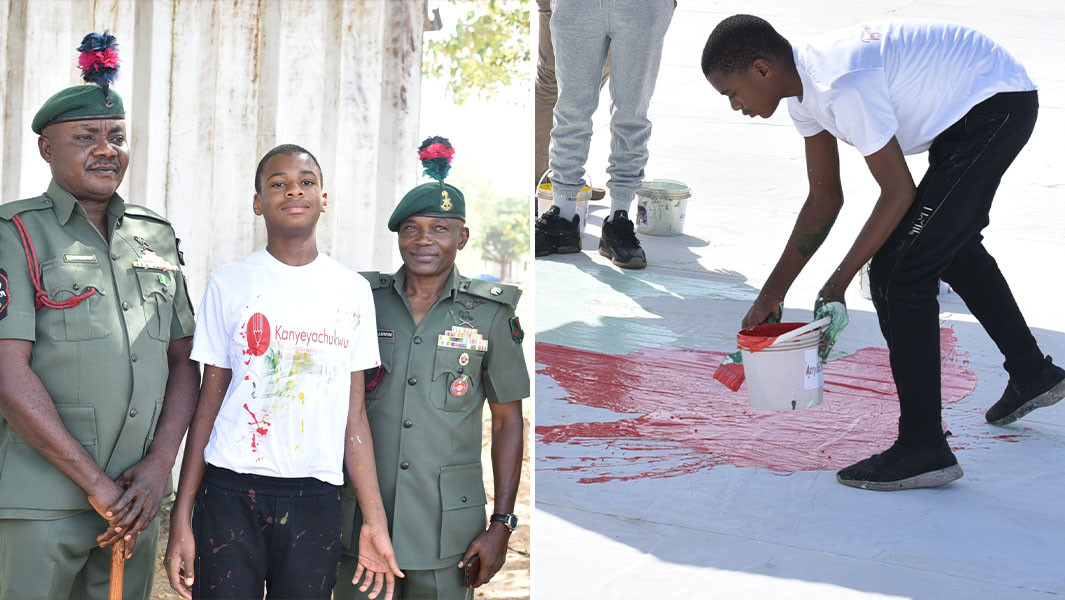
The young Nigerian artist’s canvas received public recognition in Abuja in April 2025. Guinness World Records’ contemporary account described the project and the national attention surrounding it. This is a retrospective feature about that documented achievement, rather than a claim that a new record was announced this week.
Keeping the artwork at the centre
The official record entry identifies Tagbo-Okeke as the holder of the largest art canvas title and records verification on 2 April 2025. Its stated area is 12,381.02 square metres. Using the record authority’s figure avoids mixing preliminary measurements and rounded numbers that circulated in other descriptions of the project.
The Federal Ministry of Information’s account places the unveiling and certificate presentation in Abuja on the same date. It records the culture ministry’s celebration of the artist. That official response shows the project being treated as part of Nigeria’s creative life, beyond the narrow mechanics of a record certificate.
Nigeria’s National Gallery of Art also documented its participation in the Eagle Square event. The gallery linked the presentation to World Autism Awareness Day 2025 and its support for the artist’s work. The combination of an art institution, a public venue and a measurable achievement helped bring an individual practice to a broad audience.
Yet scale is only one way to discuss a painting. A record answers a question about dimensions; it does not supply a complete judgement of artistic meaning or establish that larger works are inherently better. Readers can recognise the extraordinary physical ambition while still asking how the artist uses colour, imagery and the space available.
Recognition without reducing a person to a label
Tagbo-Okeke is autistic, a fact included in the documented coverage and the awareness setting of the unveiling. Responsible storytelling should preserve that context without presenting one artist as a test of what every autistic person can do. Individual abilities, support needs and preferences vary, and a record is not a standard anyone else must meet.
The same care applies to the language of success. An artist should be able to receive attention for making art without every account turning into a simplistic story of overcoming a personal condition. Creative achievement and the need for accommodation can exist together. Recognising one does not remove the importance of the other.
For cultural organisations, the practical implication is to think beyond invitations to a single high-profile ceremony. Accessible communication, predictable arrangements, suitable exhibition spaces and respectful collaboration can affect whether an artist can participate comfortably. These are useful questions for galleries to examine; the record itself does not establish how widely such support is currently available.
There is a similar distinction for audiences. Admiration becomes more substantial when it includes curiosity about the work, its presentation and the artist’s choices. Sharing a photograph may introduce a name, but meaningful cultural attention also makes space for continued practice after the exceptional event has moved out of the news cycle.
What should follow a milestone?
A giant artwork creates unusual practical questions about storage, display and public access. Its size may be part of its appeal while also making it difficult to encounter in the same way as a conventional gallery painting. Clear documentation helps audiences understand the work even when they cannot stand in front of the full canvas.
The April 2025 achievement therefore remains relevant as an example of how recognition is built and how it might be extended. The certificate marks a specific accomplishment. A more inclusive creative environment would be measured through continuing opportunities for artists with different ways of communicating and working.
Tagbo-Okeke’s name deserves to stay attached to the painting and the verified accomplishment. The wider conversation should leave room for other artists whose work is quieter, smaller or never record-breaking. A culture that can celebrate an extraordinary canvas can also ask whether its everyday spaces allow a broader range of people to create.
Discover more from PMNBuzz.com - A PRIME MEDIA NETWORK BRAND
Subscribe to get the latest posts sent to your email.






